Criticism · Diary · 2024
The Queue Diaries
Venice Biennale 2024
A diaristic account of Venice Biennale opening week, told through its queues, parties, crossings and shifting encounters with the condition of being foreign.
April 15 22:24, Piazza San Marco 310: I’m queuing up for the toilet at Al Campanile. There’s just the single toilet. Outside, a group of drunk Slavs are offering Ukrainian cocaine to an Albanian waiter in exchange for a bottle of Prosecco. Yesterday I arrived from Milano, hoping for some quiet days, but quiet days seem so far away. I saw an amazing exhibition today. Jecza Gallery is showing Tincuta Marin in a small chapel across the square from Combo. The chapel itself is magnificent – Andrei Jecza, Tincuta’s gallerist, explained to me this was one of the rare chapels in Venice which are painted by the same artist in whole – I obviously forgot who. Tincuta’s installation is mindblowing. Four seemingly unfinished canvases positioned in a square facing away from each other are supported by four bronze sculptures of unknown creatures that resemble Egyptian deities. I first saw Tincuta’s work in 2020 at Vienna Contemporary, where I first met Andrei too, and she has since then been my favourite young painter. Still, I’m reminiscing of the quiet Venetian winter nights.
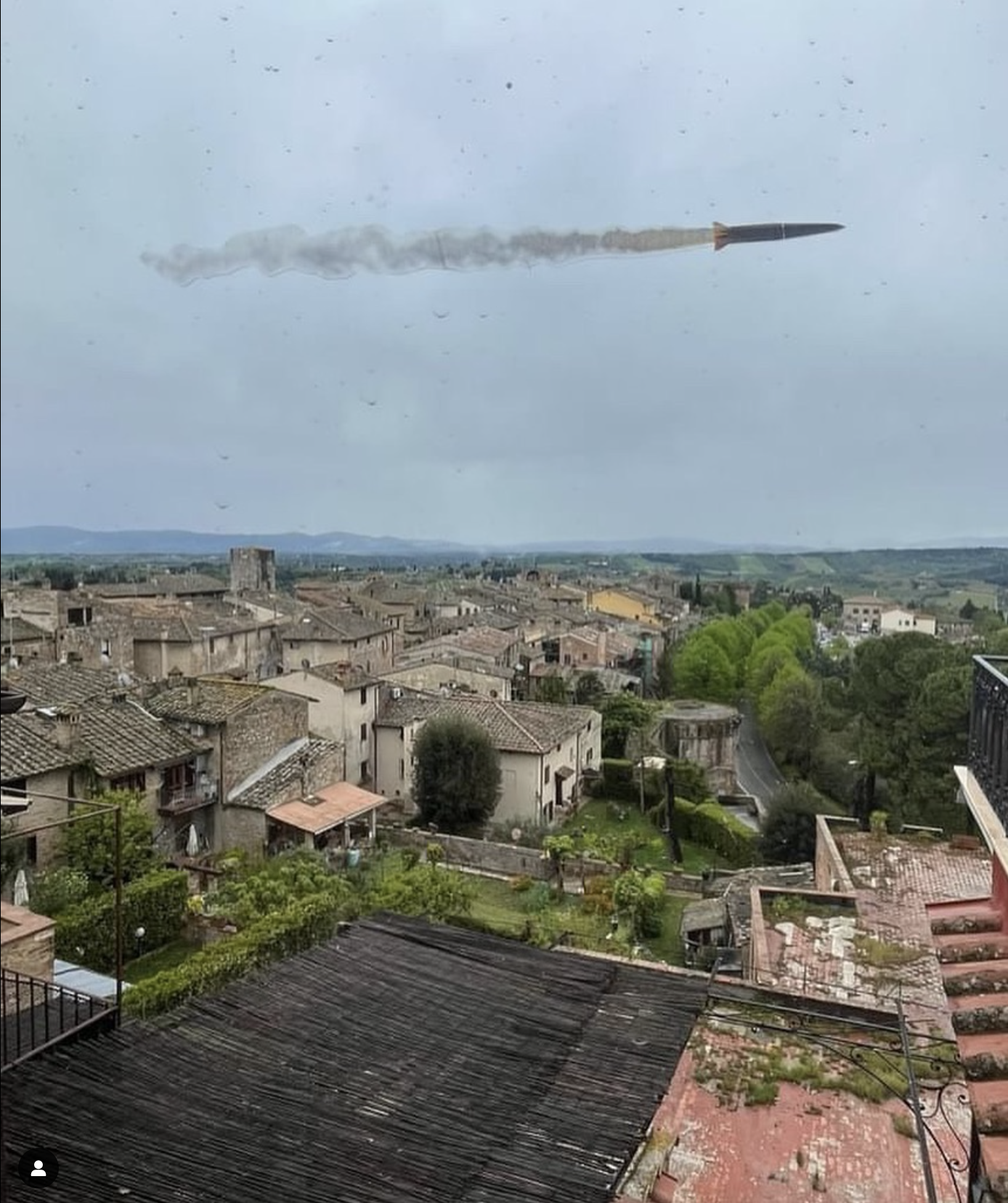
April 15 23:58, Calle de la Chiesa 684: I’m queuing up to get my last drink at Corner Pub, a Milano Torino. I followed the drunk Slavs under the pretence I'm being led to some palazzo, but I ended up sitting on the stairs of a bridge. One of those drunk slavs is Zhanna Kadyrova, who I am so happy to have met. Zhanna is one of Ukraine’s most prominent artists. Her project Russian Rocket, which I became fascinated by a couple of months ago, is an online collection of videos showing a transparent sticker of a russian missile stuck to windows of trains and aeroplanes, flying around the world. This humorous but incredibly on point project reminds us of just how close we are to the war, wherever we might be. On the way here, my friend Elia Rosa Guirous Amasse and I met the producer of the German pavilion whom we interrogated on his opinions about hyperfemininity. In return, we got invited to the German party. On Thursday night on La Certosa. I decided there and then that I’m not going, but Elia seems excited. They’re a clubber. They are also the assistant curator of the first Seychelles pavilion and she’s having a late night curatorial emergency, she’s been on the phone for two negronis already. I hear my friend Stefano Cagol shouting my name from behind the corner. I thought he had left an hour ago, but he’s there, holding a magnum bottle of Franciacorta. Behind him, a door opens into a church.
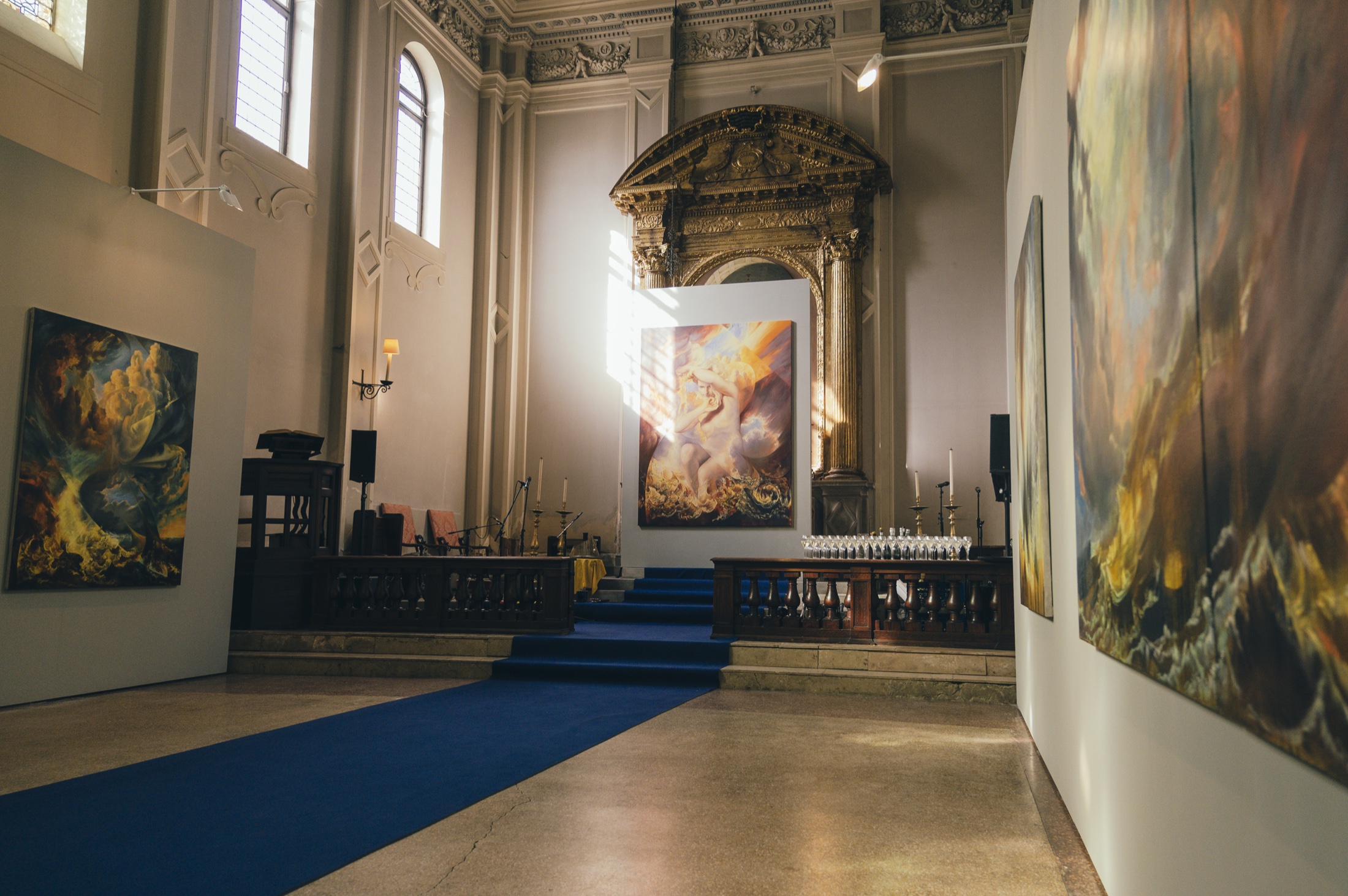
April 16 01:37, Campo San Vio 729: I’m queuing up, holding my champagne flute, to get a refill, at St. George’s Anglican Church. Stefano has a good nose for these things. Right under my nose, while I was sitting on the floor with the drunk Slavs, Maria Kreyn, a Russian born American painter, was previewing her exhibition that opens tomorrow. Chronos, a series of monumental paintings revisiting the mythology of time, is painted in a romantic style, with each painting opening a portal into the supernatural. Finally, this week started well. I’ll drink this glass and leave, it’s getting late.
April 16 21:47, Riva Ca' di Dio 2181: I’m queuing up to get my coat back at Ca’ di Dio. UAE hosted a beautiful alcohol free dinner. They lost my friend Elia’s sweater, though. It is very cold outside and she’s wearing the most amazing red dress designed by Ayoub Moumen of Refugee Engaged Wear. I don’t think I’ll ever forget the sight of her walking towards me a couple of hours back. Not much happened today though. I got a haircut, I had a quick walk through the biennale before it gets crowded by the not so VIPs tomorrow. My favourite for now (since everyone is asking) is the Polish pavilion by the Ukrainian Open Group. Repeat After me II is an interactive video installation of two videos, one from 2022 and the other, new, from 2024. The protagonists of the films are refugees, speaking about the war through the sounds of weapons they recall, which they invite the audience to repeat. The Open Group and curator Marta Czyż have thus created a military karaoke of the future, joining the public and war witnesses in dialogue. Many people didn’t seem to like it today, though. Maybe this harsh war humour is something only us Slavs can understand. As Todd McGowan observes, we are “secretly philosophising when we engage in comedy”. The power of comedy is not in mocking human dignity or constantly laughing at life's absurdities. Instead, comedy highlights the power of negativity, which is embodied in real individuals as the only true universality. This power of comedy is largely seen in jokes coming out of Eastern European contemporary war zones since the Yugoslav wars.
April 16 22:35, Fondamenta Arsenale 2168: Elia and I are trying to find the entrance to the next party. Lightbox Group and Alserkal Foundation opened a show today curated by my compatriot Nataša Petrešin Bachelez, but it seems we missed it. We spent almost an hour looking for Elia’s sweater at Ca’ di Dio. Her red dress keeps distracting my thoughts. I’ll invite her for a whiskey sour at Oriental. I want to see her and her red dress there.
April 16 23:49, Sea Pearl docked at Riva San Biasio: We’re queuing up to board the Sea Pearl, but nobody seems to know who we are. Some time ago my friend Firouz FarmanFarmaian joined us with his wife Camilla and his cousin Amir. Firouz is opening an exhibition on thursday, presenting the second stage of his last Biennale’s piece Gates of Turan at Galleria Itinerarte. It seems the party we want to go to is actually tomorrow. I’m quite drunk already. I’m really happy I met Christopher Joshua Benton at the UAE party, who, by the way, found the entrance to the Alserkal party at the Navy Officers’ Club while Elia and I were sipping cocktails and talking about orientalism. I’ve been following his work for a while. This Abu Dhabi based American born artist, who previously worked as the global creative director of Huawei, is researching the social inequalities of the Emirates in a visually appealing but incredibly precise way. I want to work with him.
April 17 00:22, Campo San Lorenzo 5069: We’re queuing up to enter the Ocean Space. Everybody seems to be here. But the party is ending and the guards are not letting anyone else in. The music sounds great. I’m checking my phone to find someone to get me in, but I’m too drunk. Firouz and Camille decide to leave. Amir and I decide to walk Elia home. Ocean Space opened another one of their large scale exhibitions two weeks ago. Entitled Re-Stor(y)ing Oceania, the show comprises two site-specific commissions by Indigenous practitioners from the Pacific, Latai Taumoepeau and Elisapeta Hinemoa Heta.
April 17 19.00, Calle Stua 3628: I’m queuing up to be seated at Vini da Gigio with my friends from Slovenia. Everyone arrived today, it was a crowded, too crowded day. I woke up early to see the preview of Osman Yousefzada’s show Welcome! A Palazzo for Immigrants curated by Nadja Romain and Amin Jaffer. This intervention at the Palazzo Franchetti is a continuation of Yousefzada’s artistic investigations into displacement, migration, class and climate change, interweaving these themes with new mediums and techniques that re-contextualize his artworks within the Venetian context. Presented by Fondazione Berengo in partnership with the V&A Museum, the show boasts an incredible assortment of hand blown glass pieces and textile fibre sculptures. It is the best show I’ve seen today. I also stumbled into Lisa Kandlhofer and her fiancee there, we ended up having early morning Bellinis at Experimental. But anyway, Vini da Gigio is one of my favourite spots in Venice, with a classic Venetian menu and probably the best wine list in the city. I’m looking forward to this dinner. Firouz and Camille cancelled at the last minute so my friend Nina picked up two Dutch collectors at Vino Vero. She likes to pick up people. Her spotlight shines brightest on asset-rich-cash-poor European aristocrats. Also I just figured out I forgot the Dutch couple’s names, fuck.
April 17 23:49, Sea Pearl docked at Riva San Biasio: I’m queuing up to board the Sea Pearl, again. This time I’m here at the right time, but nobody knows who I am. So I said I’m Firouz FarmanFarmaian. And my friend Katarina is Camille, and my friend Elia is Amir (they’re queer, they’re ok being a 60 year old Oxford-educated Persian historian/forex trader). But Amir is not on the list either, so he has to wait outside until I talk to the host. The real Amir was actually supposed to join us, but he wandered away somewhere on the way.
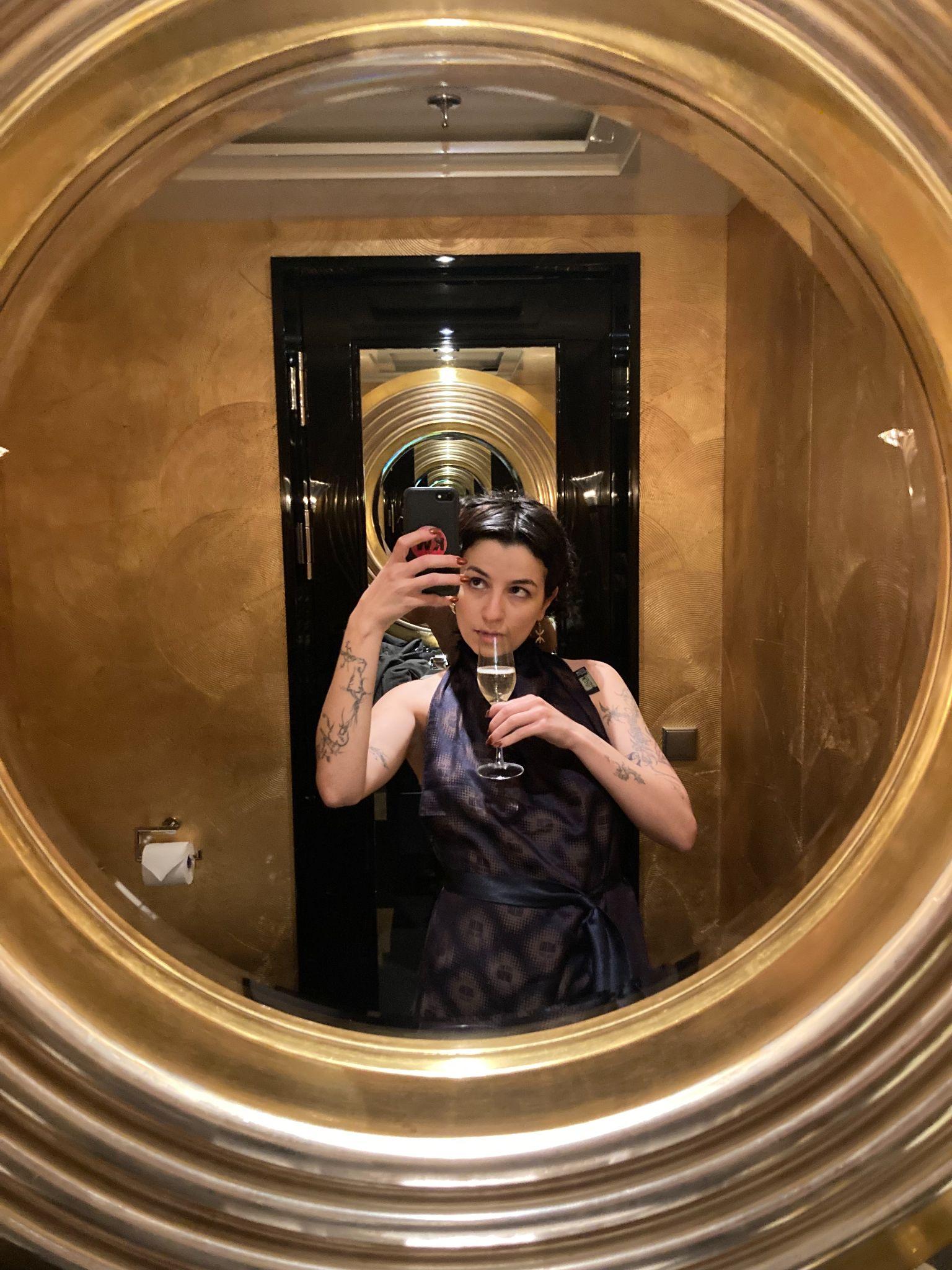
April 18 00:26, Sea Pearl docked at Riva San Biasio: I’m queuing up for the toilet at the Sea Pearl. Elia is inside taking selfies, I’m sure. I managed to get her on the yacht. The hostess is actually very kind. Aarti Lohia, the famous Indian heiress collector is this year’s British Council’s Venice Biennale Ambassador, whatever that means. But I’m glad she let Elia board. I’m not sure where Katarina is. Probably downing a bottle of Dom Perignon somewhere. There’s nobody to talk to on this boat, I tried, they’re all either suits which I’m not interested in or 30k-worth-of-designer-clothes-wearing-hotties not interested in me. I feel like there’s someone watching me all the time.
April 18 01:39, Sea Pearl docked at Riva San Biasio: We got kicked out. I’m not sure if because the event ended or Katarina insulted someone. It all got very weird all of a sudden. All the men left and the hostess and her girlfriends started dancing on tables. I’m very champagne drunk. Rick Owens is throwing a party for Michele Lamy’s 80th birthday on Lido. But I don’t think I can make it there. Even Elia agrees. And she’s a raver. I’m sure the queue is massive. During this boring party I reflected on the biennale a bit, now two days in. Being a nomad, a foreigner everywhere, I tend to question the contemporariness of this topic. Does globalisation not finally make us the romantic ‘citizens of the world’ and the word foreigner remains in the past with blitzkrieg and bubonic plague? Almost a third of the artists presented in Pedrosa’s show are dead. Shouldn’t the Biennale be about the future, not history? Is the western world becoming traditionalist in order to preserve unity based on history instead of common desire?
April 18 19.21, Calle Nuova Saint’Agnese 874: I’m queuing up to see the preview of Pinchuk Art Centre’s new exhibition From Ukraine: Dare to Dream. Zhanna is in it. I was supposed to go to the press preview in the morning, but of course I overslept after walking home on all fours from the Sea Pearl. Zhanna said I’m on the list and of course I brought seven more people with me. We were at Firouz’s opening before. He presented a new cut of audiovisual poem Shimmer to mark the two year anniversary of his Gates of Turan installation in the Kyrgiz pavilion at the 59th Venice Biennale. Also, it seems I’m not on the list, again. And Zhanna is not answering. I’m too old for this shit.
April 18 23.11, Riva degli Schiavoni: I’m queuing up for the shuttle to the Irish and Icelandic party. Katarina is with me and Andrei was waiting for us here. I hope he didn’t wait too long. Firouz invited us for dinner to a lovely Afghan place in the far Western end of Dorsoduro. It took me and Katarina 45 minutes to get back to San Marco, but the food was worth it. After being in Venice for some time, I crave foreign cuisine. It seems we’re too late for the party. I’m on the list, but not on the right list. I didn’t know there were two lists. But the pier next door seems to be leading to a Gagosian party, Andrei says. Let’s queue up there.
April 18 23.58, Fondamenta S. Giacomo 193: I’m queuing up to enter the Gagosian party. It’s a shitshow. A White Cube staffer is doing lines on the stairs of the church behind the corner, some Brits from V&A are fighting with the bouncer saying “Do you know who I am?” and an Israeli lady with a really hot ass is smoking something smelling pretty weird in front of me. Andrei seems pretty eager to enter, but I don’t think it’s going to happen. I finally saw the show of Troy Makaza earlier today. On Miart, last week, I bought one of his works. This young Zimbabwean artist creates tapestries out of silicone, using a silicone gun to apply the material instead of a mould. Viewed from afar, the carefully layered strings of colourful silicone seem weaved as strings of wool. Makaza is representing Zimbabwe with a pavilion behind Hotel Danieli.
April 19 01.15, Redentore Vaporetto Stop: We left. We’re hitching a ride back to San Marco in a taxi with some Russians. Andrei organised. He’s good.
April 19 01.51, Piazza San Marco 310: I’m queuing up for the toilet at Al Campanile again. Katarina is at the bar. I just want to sleep. Those Russians from the taxi were no fun. Andrei tried talking to them, but they were just too rich for us it seems. Andrei left after. He’s a serious man. I’m leaving too after this piss.
April 19 11.20, Calle S. Biasio 2131: I was queuing to enter the Albanian pavilion together with my friend Carmen Lorenzetti but it just started raining like hell so we went to hide in the Panama Pavilion, which is, luckily, just having a preview breakfast with some amazing rum older than me. And crepes with prosciutto and good coffee, Carmen says. Yesterday night I left Katarina at Al Campanile. She came home when it was already light. I had a good night’s sleep. It was my first sober night since Saturday.
April 19 14.03, Giardini: I’m queuing up to see the Egyptian pavilion. The queue goes all the way to the Brazilian pavilion. Before, I saw Thierry Geoffroy, who launched his retrospective book A Propulsive Retrospective edited by Christian Ganzenberg. Thierry, nicknamed Colonel, is a brilliant persona, a Biennale veteran, who, with his interventions into all large art events, interrogates and reflects on, as he puts it, ultra contemporary issues. I’m giving up on queuing. I'm going to eat something before my talk with Firouz this afternoon. Katarina is still asleep.
April 19 21.42, Fondamenta Trapolin, 2386: I’m queuing up to enter Palazzo Diedo. This seems to be the motherqueue of this year’s opening week. Some two hundred metres long, this queue spans from the entrance to the palazzo, across two bridges, all the way to Strada Nova. I need an alternative solution. I’ll try a different path.
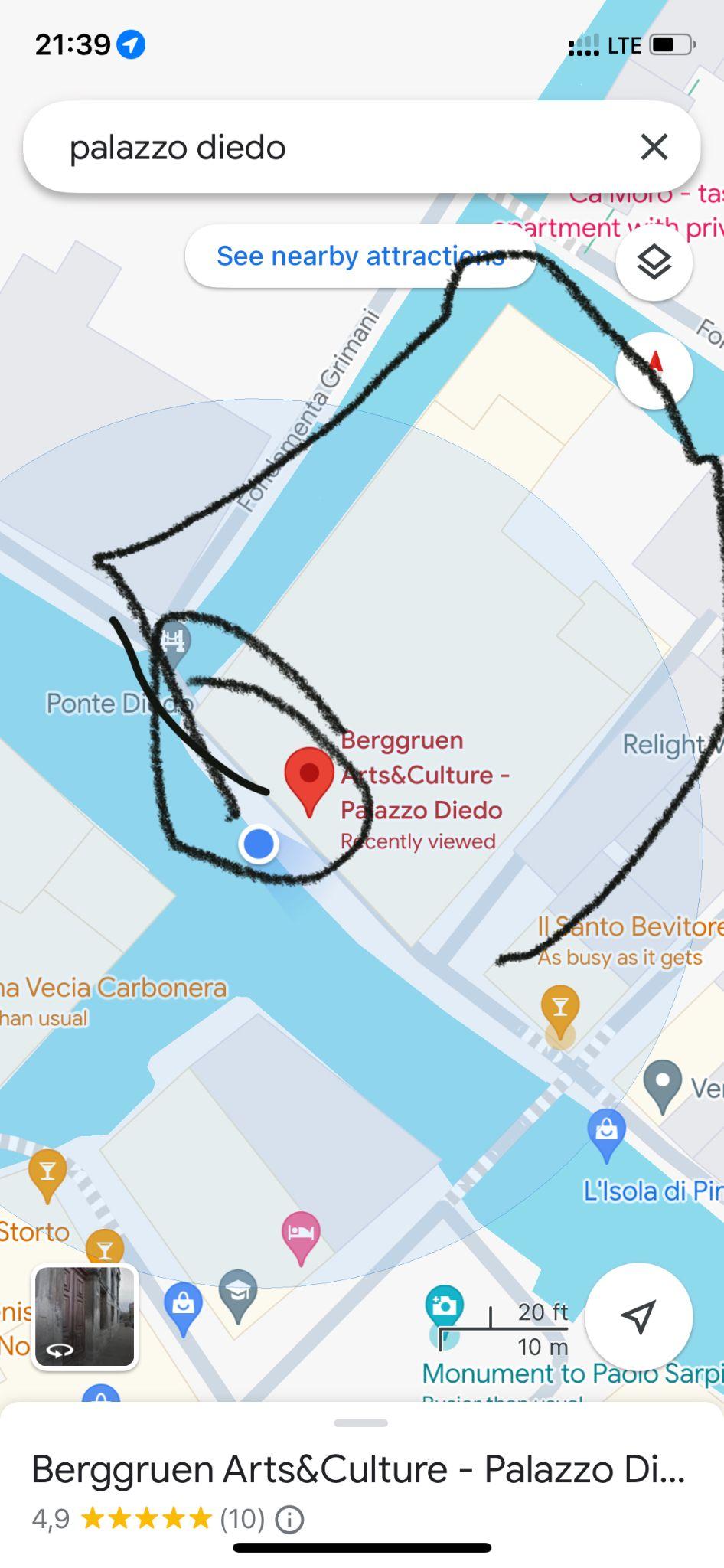
April 19 21.45, Fondamenta Trapolin, 2386: I’m queuing up to get a gin tonic at Palazzo Diedo. My alternative route worked. Weirdly, all I needed to do was go around the building and approach the same entrance from the other side of the street. Elia joined me too. The manoeuvre didn’t seem so simple to them, so I had to draw her a map. The space is beautiful. It is the first new large space focused solely on contemporary art after the Ocean Space opened in 2019. I live just around the corner, so I was looking at the reconstruction of the building for the last year, until the very last moment a week ago when it still seemed like it’s definitely not opening today. Even today, people say, there were still cranes inside the lobby. I’m not going to see the show, it’s too crowded. It really seems like this is the party of the week. I’ll just order four gin tonics for me and four for Elia, it sounds like a good idea.
April 19 23.49, Fondamenta Trapolin, 2386: I’m queuing up for another eight gin tonics. Katarina joined. And Elia’s friend Axel Besson from Paris. And Nina and Andrej. And Carmen and Ross. It seems like the whole entourage converged into this place and nobody really knows what we’re doing. An american painter told us there’s a guy repairing the elevators next to the back exit and if you give him 10 euros he lets you do coke in the back room. Good piece of info. I think I want to rather know what’s up on the second floor, maybe the elevator guy will get me up there for 10 euros. I’m sure the gin tonic queue is shorter up there and the terrazzo is shinier. Terrazzo is always shinier on the other side.
April 20 01.15, Campo San Samuele 3231: I’m queuing up to enter the afterparty at Palazzina Grassi. Katarina dragged me here. When Ross told me about this party, he only said he was told we should arrive early as it’s going to be a shit show. And it is. It’s another shitshow. I bumped into the Russian performance artist Petr Davydtchenko in the crowd though. It’s always fun to see him. We decide to steal a boat to reach the palazzina from the other side. Katarina thinks it’s a bad idea. The woman with Petr doesn’t talk. Or maybe I just don’t listen. Perception is slowly becoming foggy and I really need to pee.
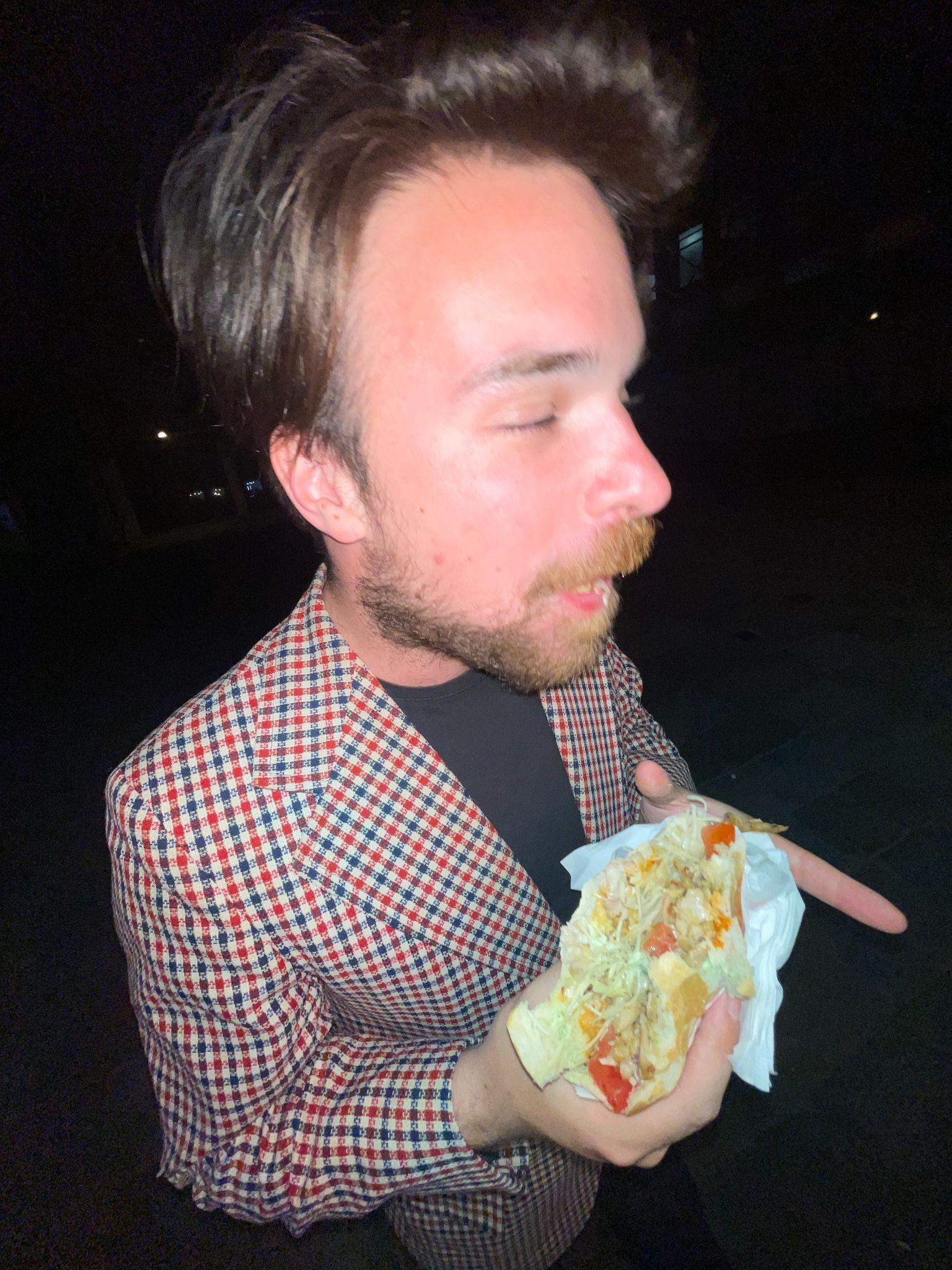
April 20 04.41, Campo Manin 4253: I’m queuing up to get a döner. Petr and I couldn’t steal any boats because they were all too fancy and had keys. Or we were too drunk. He went home and Katarina and I joined my new Ukrainian friends at Rialto, for some last drinks. We sang slavic songs and drank wine from big plastic bottles. I will miss them. I got my kebab finally. I had a half chicken, half beef, with everything, extra spicy. This kebab place is the last place open in the city, which, obviously, doesn’t make it particularly good, but it does make it weirdly enjoyable. Once, a drunk Venetian sailor called Max told me that when there is no choice the only choice is the best choice. Döner is this choice. The true power of döner kebab is in its singularity, being the only choice – and the subsequent universality. In art, we constantly strive to find the universal language, the omni-comprehensible message, that the kebab industry has found so simply by creating a product which is a foreigner everywhere and hence universal. In the 1960s, Turkish gastarbeiter became the largest group of immigrants in West Germany, significantly influencing the country's culture, notably through the creation of the Döner Kebab. Kadir Nurman, who moved to Berlin in 1966, is credited with inventing the portable Döner Kebab in 1972 by serving kebab meat in a sandwich form, catering to the needs of working-class people seeking convenient, on-the-go meals. This innovation transformed the traditional perception of kebabs and became a symbol of cultural integration in Germany, and grew to become the world’s most famous street food. The dish, although based on a traditional middle-eastern meal, came to existence through cultural assimilation and spread around the world without a clear sense of its provenance, similarly as a religion or a myth, serving as a solution to the problem of late night hunger. While eating this kebab, my perception of this year’s biennale’s focus fluxed. Can Foreigners Everywhere mark a drift away from the post-colonial research and the constant search for individual histories and references into a more universal art scene, freed from its historical and national bounds, striving towards a global society of foreigners where the idea of foreign gradually ceases to exist? Or maybe I just need another kebab.